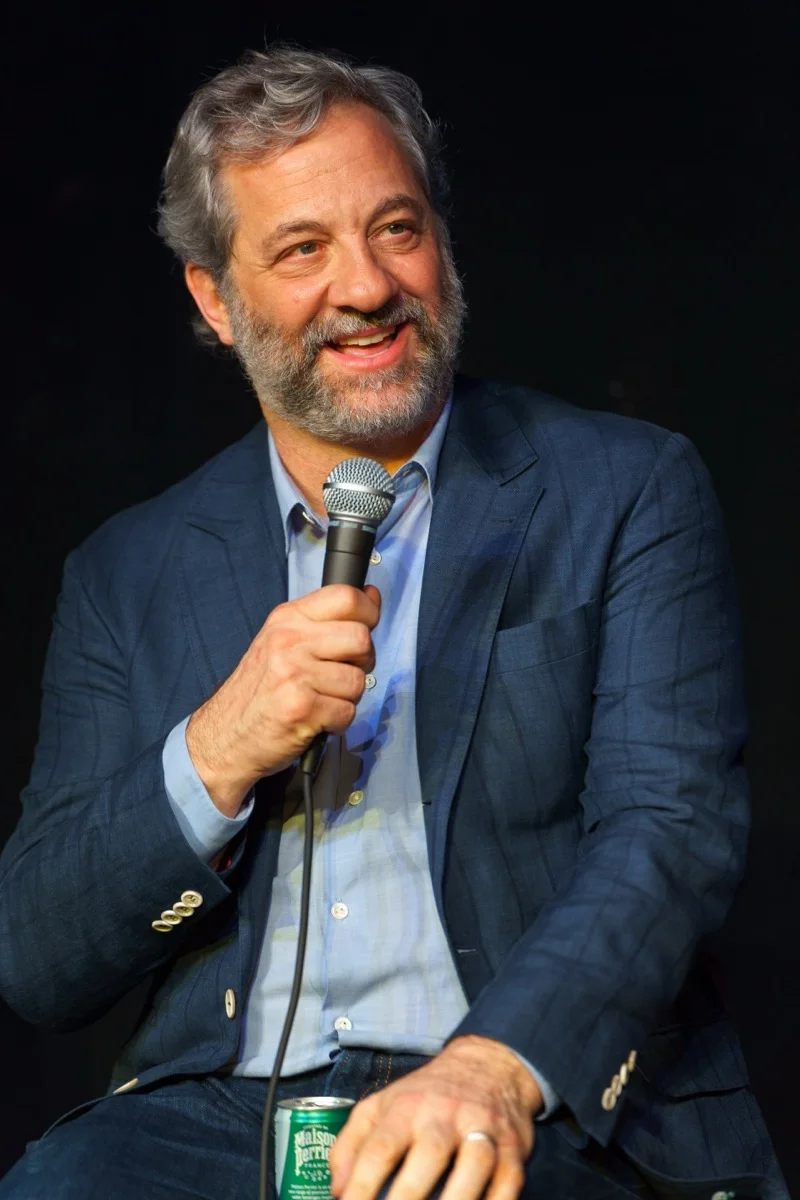
Judd Apatow
Filmmaker and Comedy Producer
Director of The 40-Year-Old Virgin and Knocked Up and the producer behind two decades of American comedy. He signed the 2025 Hollywood letter opposing AI copyright exemptions and describes generative AI as factory logic: scraped, generic, and missing a point of view.
Why this score
How the formula works →- +2.6antiSigned an anti-AI letter
- +2.0antiCalls AI overhyped
- +1.7anti4 anti-AI statements (forceful)
- ±0nuancedHolds a documented two-sided view
Weights, statement counts, the ×1.25 multiplier for having a stake in an AI-impacted field, and the formula’s smoothing are already baked in — the points add up to the score (direction-free evidence pulls toward the middle instead): Firmly Anti-AI · 6.3/10
In his words
The writing and the directing will always wind up generic because it’s scraped and it’s just copying other things.
There are definitely ways that technology can help people. If you can go on a computer and make it look like deep space and it doesn’t cost $3 million, it costs 40 grand. Well, clearly in some ways that will help people. It will decimate the people that made space.
Biography
Judd Apatow (born 1967) is the writer-director-producer who rebuilt the American studio comedy around emotionally stunted men and improvising ensembles. He created Freaks and Geeks and Undeclared, directed The 40-Year-Old Virgin, Knocked Up, Funny People, Trainwreck and The King of Staten Island, and produced Anchorman, Superbad and Bridesmaids. He also curates comedy history: a documentary on George Carlin, a book about Garry Shandling, and the 2025 scrapbook memoir Comedy Nerd.
The factory question
Apatow was a loud voice during the 2023 WGA strike, where AI protections were a core demand. In March 2025 he was one of more than 400 industry figures who signed an open letter to the Trump White House opposing OpenAI and Google’s request for a copyright exemption on AI training — a list that also included Guillermo del Toro, Paul McCartney and Alfonso Cuarón. The letter argued there was “no reason to weaken or eliminate the copyright protections that have helped America flourish.”
He laid out the reasoning in October 2025 on Kara Swisher’s podcast, promoting Comedy Nerd. Asked how a creator should think about AI, he reached for an industrial analogy rather than an artistic one.
I look at it like any other factory. If Tesla’s opening up a factory, then they’re just trying to figure out how few human beings can I use to have it function. And there’s all sorts of entities that are thinking that right now about everything to do with film and television production. Can I do this without people? Can it get written without people? Can they get directed without people?
What follows is more two-sided than his headlines suggest. He grants that cheap synthetic imagery genuinely helps people — a deep-space shot for forty grand instead of three million — and adds, in the same breath, that it will decimate the artists who used to build that shot. He expects an eventual fusion, an animation-like hybrid, and a counter-market of audiences who prefer the human version. What he does not expect is that the machine will find anything to say. Asked directly whether AI can be funny, he split the difference and then closed it.
It’s not that it would be wrong to say it can’t be funny at all, but there’s no point of view, so it doesn’t ever fully work.
Quote sources
- On with Kara Swisher, 2025(youtube.com)
Sources & further reading
Canonical record: https://battlelines.ai/topic/judd-apatow