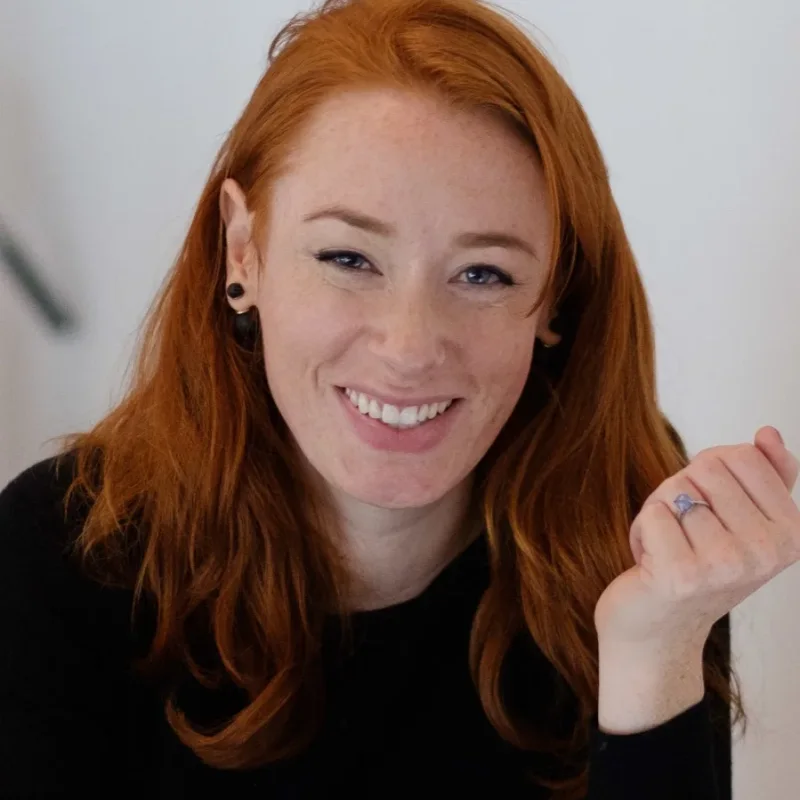
Karen Hao
Journalist & Author
Award-winning AI journalist whose 2025 bestseller Empire of AI became the defining critical chronicle of OpenAI — arguing that the AI industry operates like a colonial empire, extracting data, labor, land, and water from the many to enrich the few.
Why this score
How the formula works →- 37%nuancedHolds a documented two-sided view
- 31%nuancedFears big tech will monopolize AI
- 24%anti3 anti-AI statements (forceful)
- 8%pro1 pro-AI statement (mild)
Includes the ×1.25 multiplier for having a stake in an AI-impacted field. Evidence splits 8% pro, 24% anti, 68% direction-free → Nuanced
In her words
Every single community that I spoke to, whether it was artists having their intellectual property taken or Chilean water activists having their freshwater taken, they all said that when they encountered the empire, they initially felt exactly the same way: a complete loss of agency to self-determine their future.
Every single person should feel that they have an active role in shaping the future of AI development.
Biography
Karen Hao is an American journalist who has covered artificial intelligence for MIT Technology Review (as senior AI editor), The Wall Street Journal, and The Atlantic. In 2020 she was the first reporter to profile OpenAI from the inside — a story the company disliked enough to freeze her out — and she has spent the years since documenting the industry’s supply chain, from Kenyan data annotators to the water drawn by data centers.
Empire of AI
Her book Empire of AI: Dreams and Nightmares in Sam Altman’s OpenAI (May 2025) became a bestseller and the most influential critical account of the modern AI industry. Its central claim is that companies like OpenAI behave like empires of old: laying claim to resources that are not their own — scraped intellectual property, cheap contract labor, land, energy, and water — while justifying the extraction with a civilizing mission, the quasi-religious promise of artificial general intelligence. Hao told Democracy Now! in 2025 that communities from artists to Chilean water activists describe the same first encounter with that empire: a total loss of agency over their own future.
Hao is careful to note she is not anti-AI in the abstract — she points to smaller, task-specific systems as genuinely beneficial — but she argues the scale-at-all-costs paradigm championed by Sam Altman is neither scientifically necessary nor democratically chosen. Her prescription is resistance from below: communities protecting their data, land, water, and schools until the companies are forced to change their approach. Industry defenders counter that her colonial framing undervalues the consumer surplus and scientific progress the technology has already delivered.
Quote sources
- Democracy Now!, 2025(democracynow.org)
- MIT Technology Review, 2025(technologyreview.com)
Sources & further reading
Canonical record: https://battlelines.ai/topic/karen-hao