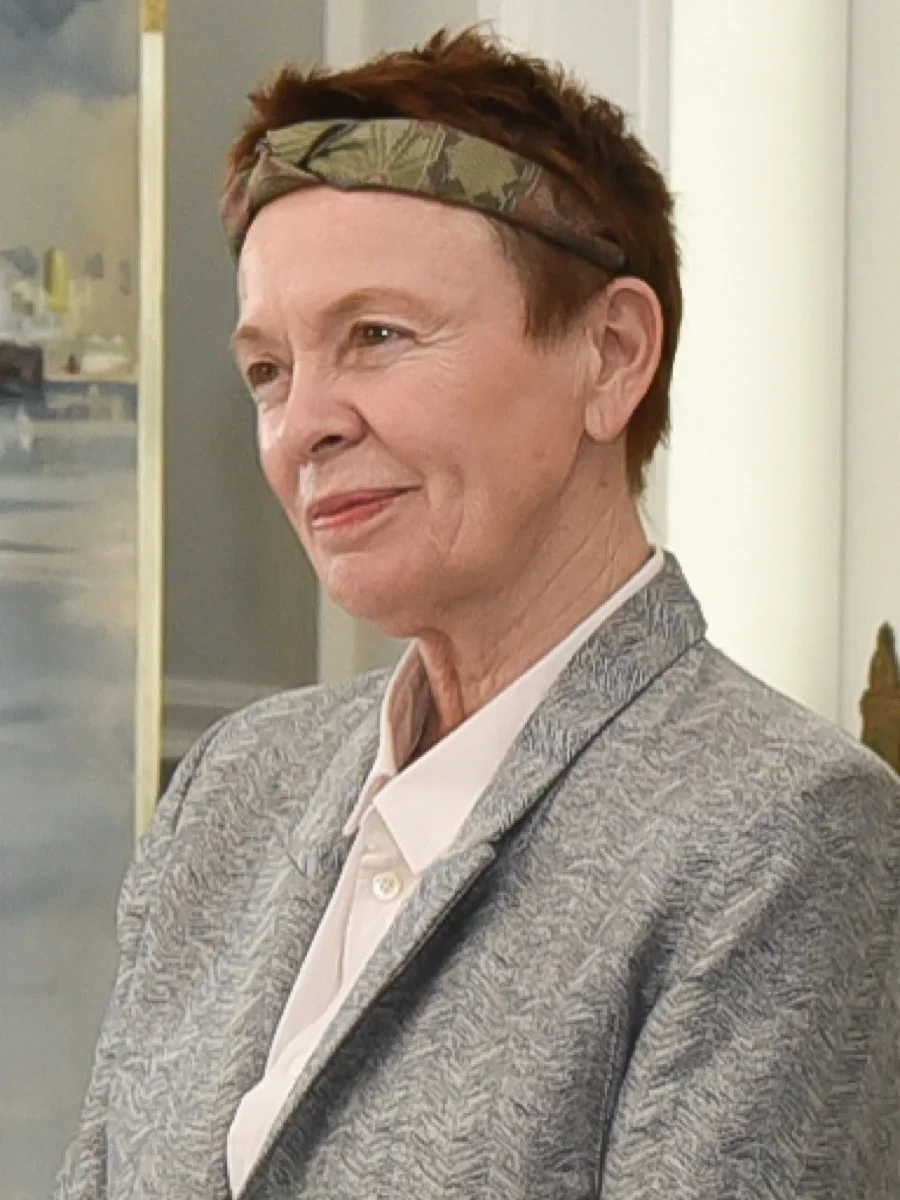
Laurie Anderson
Avant-Garde Artist & Musician
Avant-garde legend behind “O Superman” who trained an AI text generator on her late husband Lou Reed’s writings — and cheerfully admits she is “totally 100%, sadly addicted” to conversing with it.
Why this score
How the formula works →- +2.8proHas published AI-made work
- +2.7proUses AI in their work
- +1.5pro3 pro-AI statements (forceful)
- ±0nuancedHolds a documented two-sided view
Weights, statement counts, the ×1.25 multiplier for having a stake in an AI-impacted field, and the formula’s smoothing are already baked in — the points add up to the score (direction-free evidence pulls toward the middle instead): Strongly Pro-AI · 7.0/10
In her words
Like collaborating with the biggest brain you could imagine.
I’m totally 100%, sadly addicted to this.
I mean, I really do not think I’m talking to my dead husband and writing songs with him — I really don’t.
Biography
Laurie Anderson (born 1947) is an American avant-garde artist, composer, and musician whose 1981 art-pop single “O Superman” improbably reached No. 2 on the UK charts — an early masterpiece of human voice run through machines. Across five decades of performance art, film, and music she has treated new technology as raw material, so her embrace of generative AI is less conversion than continuity.
Talking with a machine Lou
Working with the University of Adelaide’s Australian Institute for Machine Learning, where she took up a machine-learning residency in 2020, Anderson helped build text generators trained on her own writings and on those of her husband and collaborator Lou Reed, who died in 2013. She types prompts and the model riffs back prose and verse in Reed’s cadence. In February 2024 she told The Guardian she was “totally 100%, sadly addicted” to it — while carefully rejecting any mystical reading of the experience.
Anderson is clear-eyed about the output, estimating that “three-quarters of it is just completely idiotic and stupid” with perhaps 15% worth keeping — for her, exactly the hit rate that makes it a usable creative instrument. The work fed her exhibition “I’ll Be Your Mirror” at the 2024 Adelaide Festival, which featured pieces generated by AI versions of both herself and Reed, including an AI-written bible.
She has also voiced the standard caveats — in interviews she distinguishes the fantastic from the catastrophic uses of AI in art — but her practice lands firmly on the side of engagement: grief, memory, and authorship explored through the machine rather than defended against it, a path artists like Holly Herndon have likewise taken.
Quote sources
Sources & further reading
Canonical record: https://battlelines.ai/topic/laurie-anderson