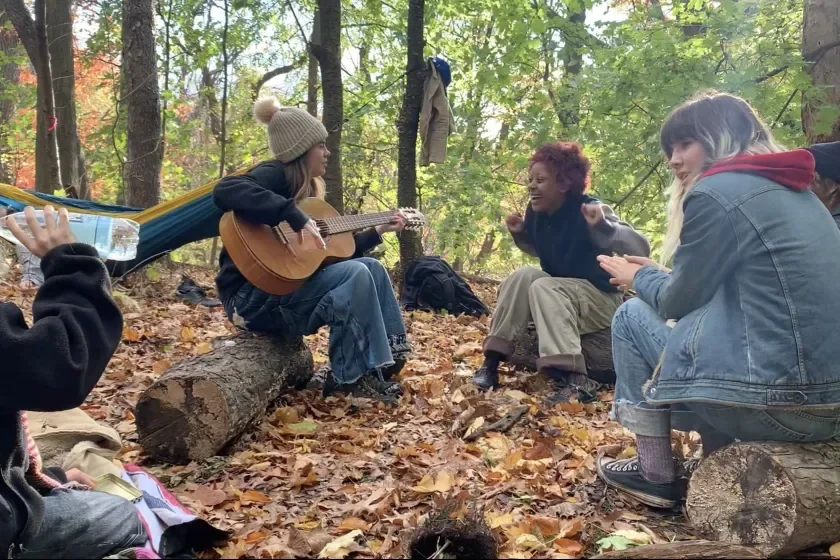
Luddite Club
Youth Tech-Resistance Group
The Brooklyn-born club of teenagers who swapped smartphones for flip phones and renounced algorithmic tech. Founded by Logan Lane, it grew into a nonprofit with chapters across the US and a touchstone of the new Luddite movement in the AI era.
Why this score
How the formula works →- +3.7antiCampaigns against AI
- +2.0antiSigned an anti-AI letter
- +0.6anti1 anti-AI statement (forceful)
- ±0nuancedHolds a documented two-sided view
Weights, statement counts, and the formula’s smoothing are already baked in — the points add up to the score (direction-free evidence pulls toward the middle instead): Firmly Anti-AI · 6.3/10
In their words
With ChatGPT at the helm, our emails, essays, and discussion posts will be generated for us. Not by us. … Rather than strengthening Silicon Valley, we build our own skills and generative sweat.
I was fed up with the over-saturation of my life and the social aspects of it being connected to my online presence.
I could feel my brain chemistry changing. I was so bored. It’s really not so common for people to be bored and be alone with themselves, because smartphones keep us connected to other people.
Biography
The Luddite Club began around 2021 when Logan Lane, a Brooklyn high schooler, deleted her social media accounts, traded her iPhone for a flip phone, and started gathering friends in Prospect Park to read, draw and talk — no screens allowed. The group took its name, half in jest, from the 19th-century English textile workers who smashed the machines threatening their livelihoods.
From park meetings to a movement
A December 2022 New York Times profile — “Luddite Teens Don’t Want Your Likes” — made the club famous, and local coverage captured its ethos: members described escaping the over-saturation of online life and rediscovering boredom, reading and unmediated friendship. The club has since incorporated as a nonprofit and expanded to more than twenty chapters at high schools and colleges across the country, including one at Oberlin, with events that court the “Ludd-curious.”
The club’s target has always been broader than phones: it rejects the algorithmic, engagement-optimized layer of modern tech, and as generative AI spread it has been embraced as the youth wing of a wider Luddite revival — invoked in coverage from CNN to The Nation as evidence of a Gen Z backlash against AI and screen-mediated life. Members frame the position as anti-exploitation rather than anti-technology, celebrating what they see as irreducibly human: art, community, play and presence.
The Oberlin chapter made that turn explicit in September 2025, publishing an open letter to college president Carmen Twillie Ambar — typed on a 70-year-old typewriter — demanding she terminate Oberlin’s contracts with OpenAI and Google Gemini, and circulating an “AI-Opt-Out Letter” for anyone who agreed. Signed by six members including founder Logan Lane, it warned that even one semester of encouraged chatbot use would send the student body “down a lazy, irredeemable tunnel of intellectual destruction,” and objected to data centers that “guzzle water and precious energy sources.”
Critics note the irony that renouncing the feed became a media phenomenon through the feed, and that opting out is easier for teens with supportive schools and neighborhoods. The club’s answer is that it asks nothing of anyone except to try being unreachable for an afternoon.
Quote sources
- Logan Lane, Chalkbeat, 2022(chalkbeat.org)
- The Oberlin Luddite Club, open letter in The Oberlin Review, 2025(oberlinreview.org)
Sources & further reading
- Chalkbeat: The anti-social network — these NYC teens are ditching their smartphones (2022)
- NY City News Service: Luddite Club in Brooklyn ditches smartphones, goes offline (2022)
- CNN: As AI gets more life-like, a new Luddite movement is taking root (2025)
- The Oberlin Review: Luddite Club Implores Oberlin to Opt Out of AI (2025)
Canonical record: https://battlelines.ai/topic/luddite-club