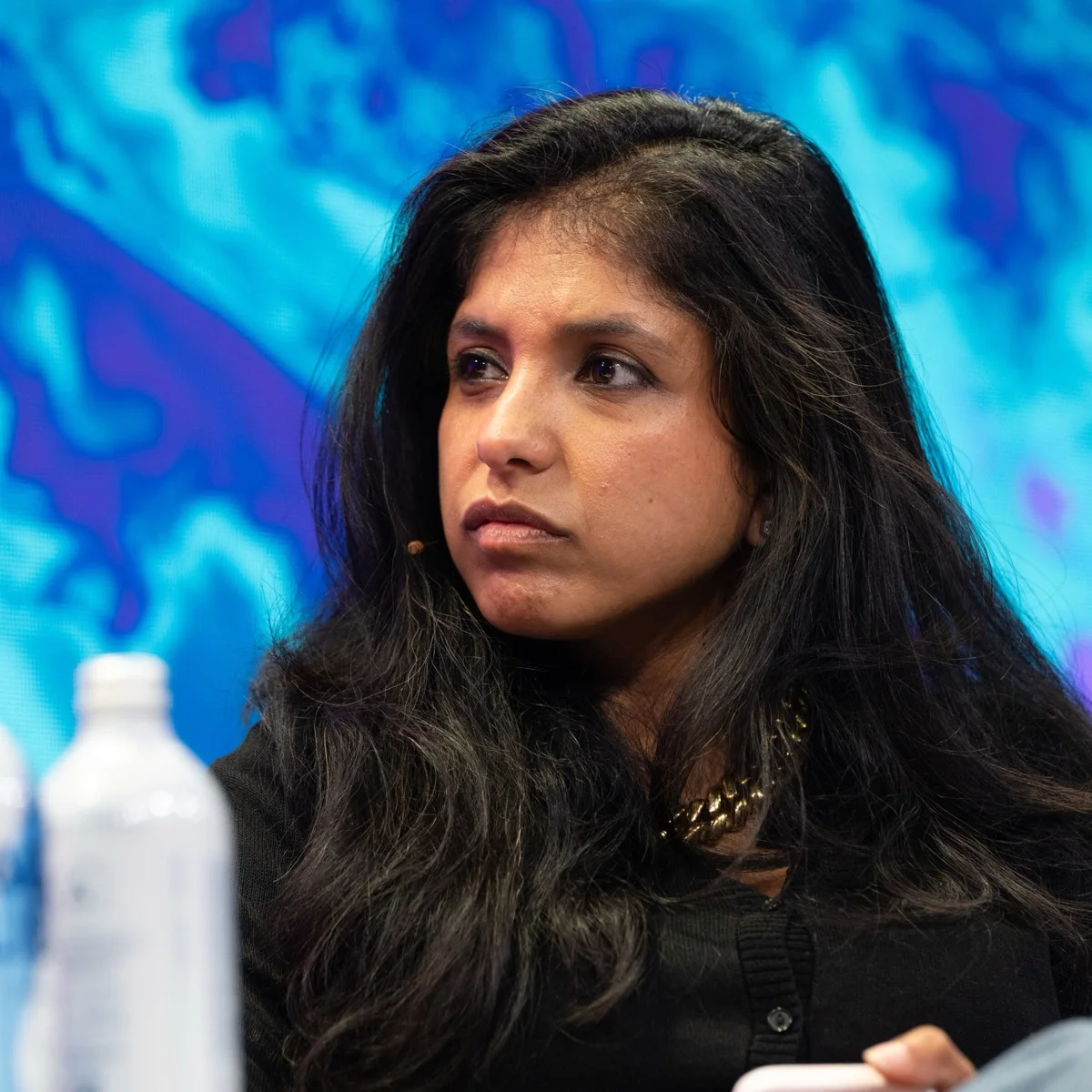
Madhumita Murgia
AI editor of the Financial Times
The Financial Times’ first AI editor. Her book “Code Dependent: Living in the Shadow of AI” documents how AI extracts labor from and inflicts harm on the world’s most vulnerable — a system she describes as data colonialism.
Why this score
How the formula works →- 38%nuancedHolds a documented two-sided view
- 31%nuancedFears big tech will monopolize AI
- 23%anti3 anti-AI statements (forceful)
- 8%pro1 pro-AI statement (mild)
Includes the ×1.25 multiplier for having a stake in an AI-impacted field. Evidence splits 8% pro, 23% anti, 69% direction-free → Nuanced
In her words
We’ve all been gaslighted into believing that AI should be used to write poetry.
Whether it was health care, criminal justice, or government services, again and again you could see the harms perpetrated on mostly marginalised groups.
Biography
Madhumita Murgia is a British-Indian journalist, born in Bengaluru and raised in Mumbai, who in February 2023 became the Financial Times’ first artificial intelligence editor. Trained as a biologist at Oxford — she did AIDS-vaccine research before switching to journalism via NYU — she covered technology at Wired UK and The Telegraph before joining the FT in 2016 as its European technology correspondent.
Code Dependent
Her 2024 book “Code Dependent: Living in the Shadow of AI” (Picador), shortlisted for the inaugural Women’s Prize for Non-Fiction, reports from the AI supply chain’s underside: data labelers in Kenya and Bulgaria, gig workers managed by opaque algorithms, doctors and caseworkers deferring to flawed systems. Murgia frames the pattern as “data colonialism,” borrowing the academic term to argue that tech companies are performing a resource extraction in which — rather than oil or cotton — “the resource is data,” and the extracted are the world’s poorest.
The book argues that this opacity is itself a harm: because ordinary people cannot see how AI systems work, they cannot comprehend when the systems go wrong or hurt them — a blindness Murgia says falls hardest on the vulnerable. She has called the implementation and governance of algorithms “a human rights issue.”
Murgia is a professional chronicler rather than a campaigner, and her critique carries a constructive edge — she has said AI should “augment us” and preserve what humans bring, and that she finds hope in the fact that “we are all still engaging with this, that we’re bringing to it our humanness, our empathy, our rage.” But her reporting’s thesis is unambiguous: as deployed today, AI’s costs fall hardest on those with the least power to refuse it.
Quote sources
- Esquire Singapore, 2024(esquiresg.com)
Sources & further reading
Canonical record: https://battlelines.ai/topic/madhumita-murgia