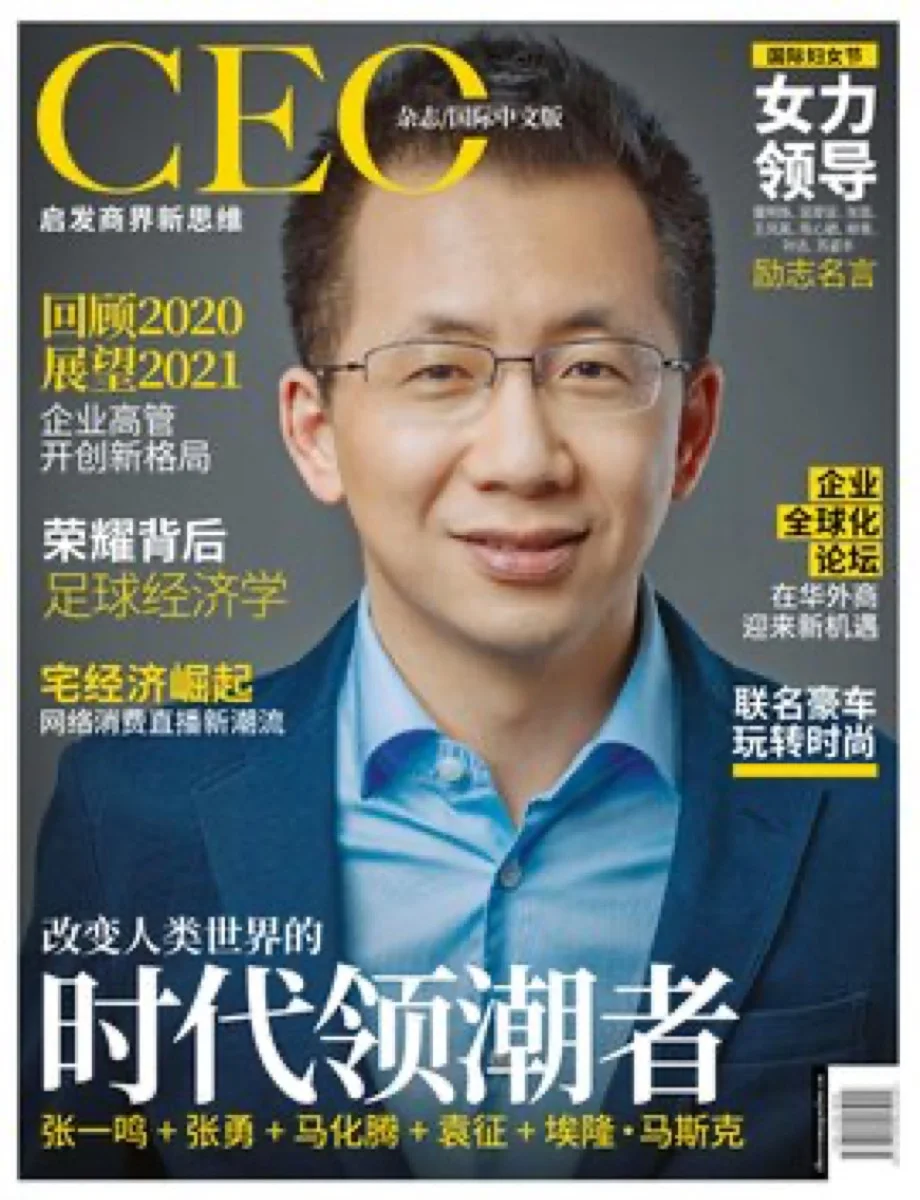
Zhang Yiming
Founder of ByteDance
ByteDance’s reclusive founder, who stepped back from management in 2021 only to return as the quiet force behind its AI push — whose Doubao chatbot became China’s most used, and whose AI bet made him China’s richest person.
Why this score
How the formula works →- +6.3proBuilds AI professionally
- +1.3pro2 pro-AI statements (measured)
Weights, statement counts, the ×1.25 multiplier for having a stake in an AI-impacted field, and the formula’s smoothing are already baked in — the points add up to the score: Strongly Pro-AI · 7.6/10
In his words
Our success over the last nine years has been predicated upon our ability to innovate at just the right moment in the development of the industry. Notably, this has included applying machine learning to mobile and video products.
Before 2017, I spent a lot of time keeping track of developments in machine learning. However, since then, while I do my best to bookmark technical articles online, I haven’t had the time to make much progress digging into the area.
Biography
Zhang Yiming (born 1983) founded ByteDance in 2012 on the conviction that machine-learning recommendation — not search, not social graphs — would decide how the world consumes information. The thesis produced Toutiao, Douyin, and TikTok, the most successful algorithmic products ever built. In 2021 he stunned the industry by resigning as CEO, writing that day-to-day management crowded out the deep technical reading he loved, including keeping up with machine learning.
The founder who came back for AI
ChatGPT ended the retirement in practice if not in title. According to reporting by The Paper and the South China Morning Post, from late 2024 Zhang began regularly flying from Singapore to Beijing to sit in on ByteDance’s core AI team meetings, studying research papers and repeatedly emphasizing the target of achieving AGI — a behind-the-scenes role colleagues compared to Sergey Brin’s return to Google. ByteDance launched the Seed research group and the Seed Edge AGI initiative, budgeted roughly $11 billion for AI infrastructure in 2025, and its Doubao assistant became China’s most-used chatbot.
In March 2025, Forbes reported that the AI-driven surge in ByteDance’s value had made Zhang China’s richest person, at $65.5 billion. He has said almost nothing publicly through it all — no keynotes, no manifestos — leaving the record to be assembled from company moves and the reporting around them, an opacity critics note fits a company whose recommendation algorithms have always been more consequential than explained.
Quote sources
- Resignation letter, via Nikkei Asia, 2021(asia.nikkei.com)
Sources & further reading
Canonical record: https://battlelines.ai/topic/zhang-yiming