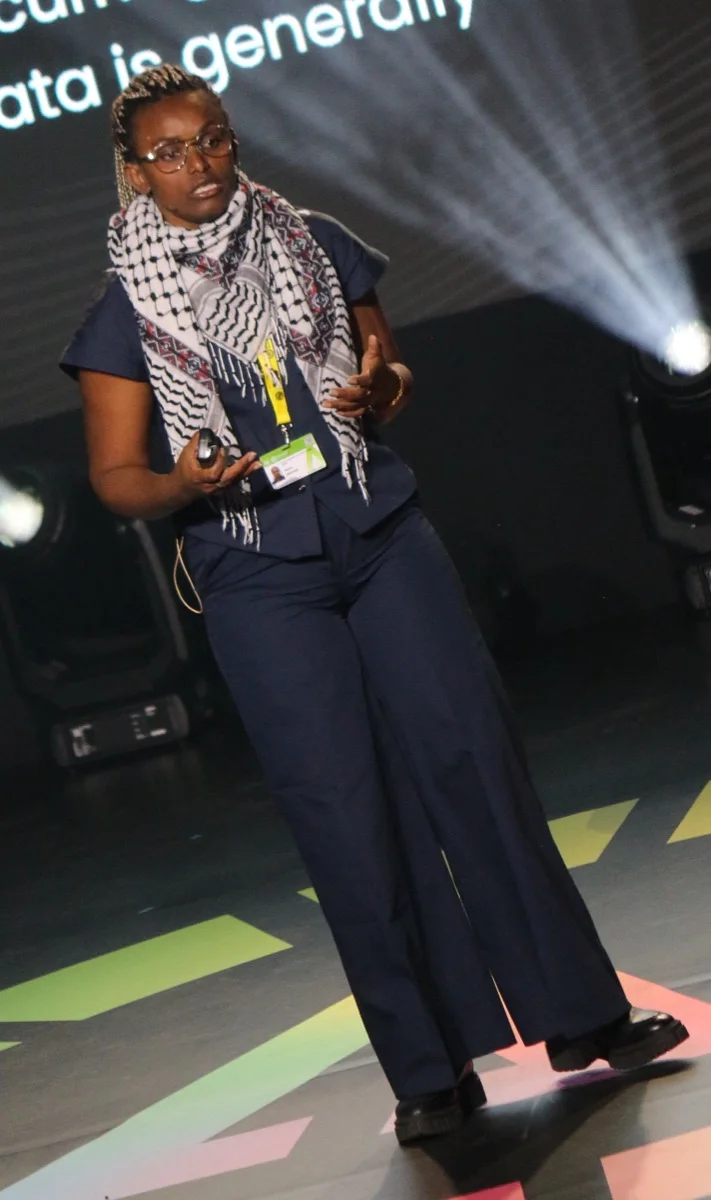
Abeba Birhane
Cognitive Scientist
Ethiopian-born cognitive scientist whose forensic audits of the datasets behind image models — MIT’s Tiny Images and the LAION collections — exposed racist, misogynistic and abusive training data, and forced at least one dataset to be withdrawn.
Why this score
How the formula works →- +2.7anti3 anti-AI statements (forceful)
- ±0nuancedWorks on AI safety
Weights, statement counts, the ×1.25 multiplier for having a stake in an AI-impacted field, and the formula’s smoothing are already baked in — the points add up to the score (direction-free evidence pulls toward the middle instead): Leaning Anti-AI · 2.7/10
In her words
We wanted to test the hypothesis that as you scale up, your problems disappear. … We found that as datasets scale, hateful content also scales.
Biography
Abeba Birhane is an Ethiopian-born cognitive scientist and one of the most rigorous auditors of the data underpinning modern AI. She earned her PhD from University College Dublin in 2022, has served as a senior advisor on AI accountability at the Mozilla Foundation, and was named to the inaugural TIME100 AI list in 2023 for work that repeatedly caught the industry’s foundational datasets in the act.
Auditing the training data
Birhane’s empirical audits exposed misogynistic, racist and explicit material inside collections used to train commercial models. Her scrutiny of MIT’s “80 Million Tiny Images” helped prompt its permanent withdrawal in 2020, and her paper “Into the LAION’s Den” (2023) showed that hateful content actually increased — by nearly 12% — as the LAION datasets grew from 400 million to 2 billion image-text pairs, puncturing the industry assumption that scale cleans itself up.
Because corporations like OpenAI tend to be completely closed, we really don’t know how they source their dataset, how they detoxify their dataset. So when you have very little information about the kind of processes they follow, it’s difficult to suggest a solution. For me, the initial step is to open up.
Beyond the audits, Birhane coined the idea of the “algorithmic colonization of Africa,” arguing that Western-built AI is exported to the Global South laden with foreign values and little scrutiny, benefiting distant tech monopolies more than local communities. Her work anchors the argument that the harms of generative AI begin not at deployment but at the dataset — a critique aligned with researchers like Timnit Gebru and Joy Buolamwini.
Quote sources
- TIME, 2023(time.com)
Sources & further reading
Canonical record: https://battlelines.ai/topic/abeba-birhane