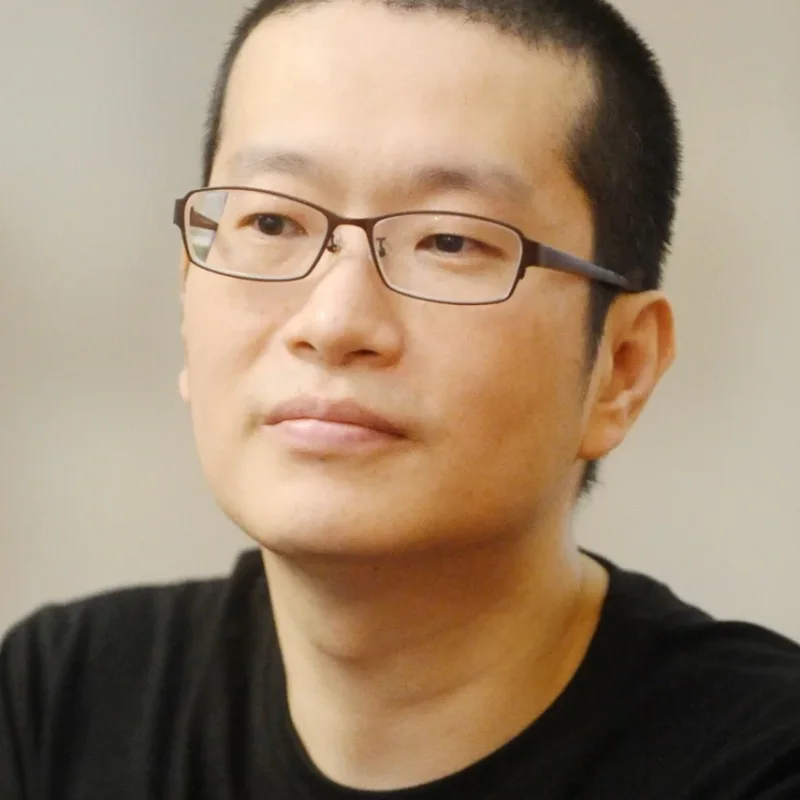
Alexander Reben
Roboticist & Artist
MIT-trained roboticist-artist who became OpenAI’s first artist in residence in 2024, turning GPT and DALL-E outputs into physical sculpture and arguing that AI is simply the newest tool in art’s long co-evolution with technology.
Why this score
How the formula works →- +2.8proUses AI in their work
- +2.7proHas published AI-made work
- +1.8proRecognized for AI work
- +1.2pro3 pro-AI statements (measured)
Weights, statement counts, the ×1.25 multiplier for having a stake in an AI-impacted field, and the formula’s smoothing are already baked in — the points add up to the score: Strongly Pro-AI · 8.5/10
In his words
I don’t call myself an AI artist. AI is simply another technological tool.
Humans are always going to be doing this stuff. We will still be painting in the far future.
Just because artwork is quick to make doesn’t necessarily mean it’s any worse.
Biography
Alexander Reben (born 1985) is an American artist and roboticist who studied applied mathematics before earning a master’s at the MIT Media Lab, where he built Boxie — a disarming cardboard interview robot that helped inspire Baymax in Big Hero 6. His career since has been a running experiment in what he calls humanity’s co-evolution with technology: social robots that film documentaries, machines that tell jokes, and sculptures dreamed up by language models.
OpenAI’s first artist in residence
Reben had tested GPT-3 years before its public release, and in January 2024 OpenAI named him its first artist in residence. During the three-month post he used GPT-4, DALL-E, and Sora to conceive works that were then fabricated in the physical world — including AI-invented sculptures carved in stone by robotic arms, and his Plungers series, which he described as flipping authorship on its head while still requiring him to sift thousands of outputs to find the one worth making.
He is candid that critics of AI art have real grievances — people take a negative view for many different reasons, he told MIT Technology Review, and they are all valid concerns — but rejects the idea that machine speed cheapens the result, pointing to the curatorial judgment involved in finding meaning among a model’s endless outputs. His work sits in the MIT Museum’s permanent collection, and he serves as director of technology and research at Stochastic Labs in Berkeley.
Quote sources
- MIT Technology Review, 2024(technologyreview.com)
Sources & further reading
Canonical record: https://battlelines.ai/topic/alexander-reben