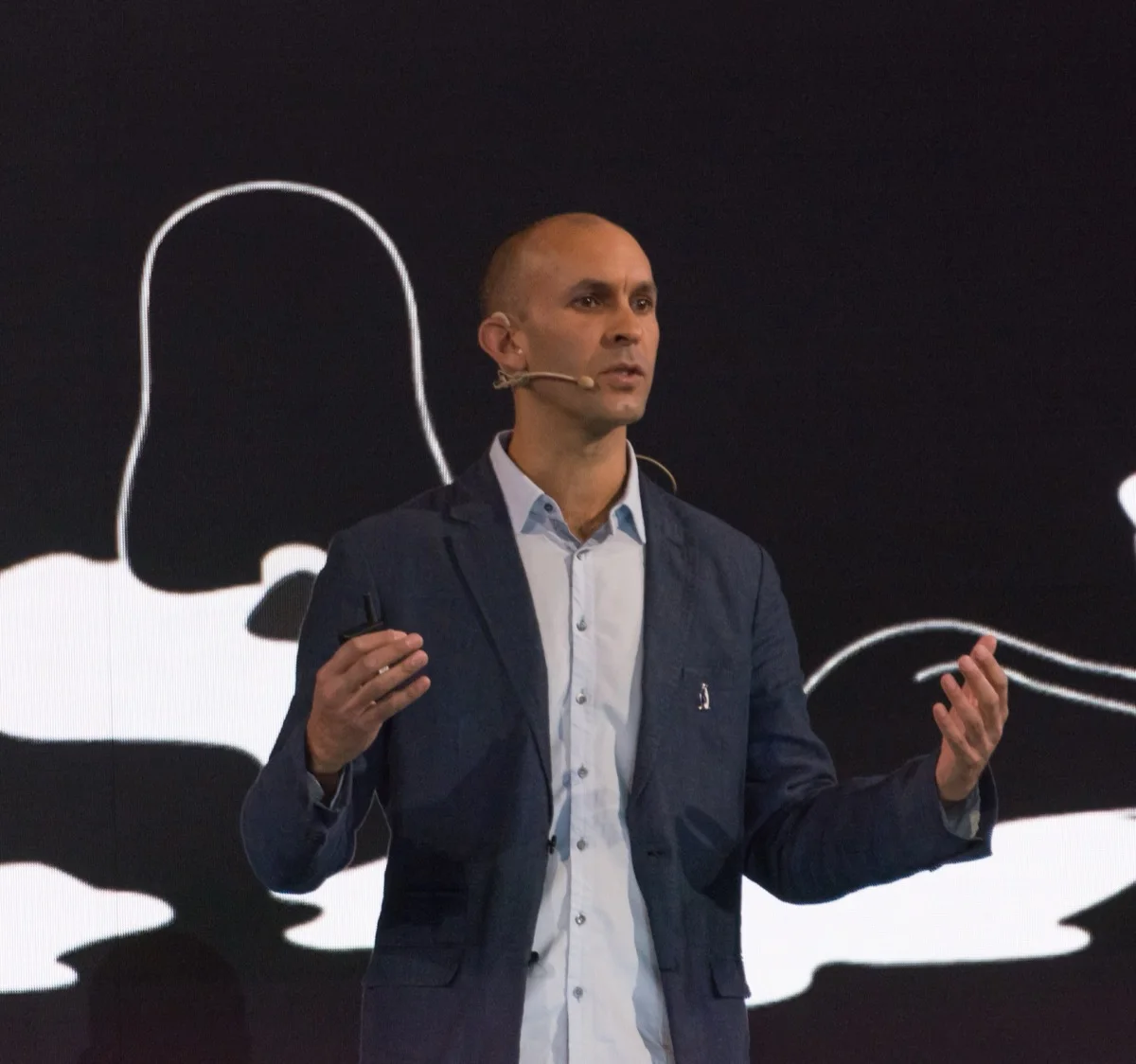
Anil Seth
Neuroscientist
University of Sussex neuroscientist and consciousness researcher whose prize-winning essay “The Mythology of Conscious AI” grants that today’s systems are genuinely intelligent while arguing they are not conscious — and that deliberately building machines that are would be an ethical disaster.
Why this score
How the formula works →- 45%nuancedHolds a documented two-sided view
- 37%nuancedSupports AI only with conditions
- 10%anti1 anti-AI statement (forceful)
- 8%pro1 pro-AI statement (measured)
Evidence splits 8% pro, 10% anti, 82% direction-free → Nuanced
In his words
The very idea of conscious AI rests on the assumption that consciousness is a matter of computation. … This assumption, which philosophers call computational functionalism, is so deeply ingrained that it can be difficult to recognize it as an assumption at all.
Biography
Anil Seth (born 1972) is a professor of cognitive and computational neuroscience at the University of Sussex, where he directs the Centre for Consciousness Science. His research and his bestselling book “Being You” (2021) advance a “biological naturalist” view: that consciousness is bound up with being a living organism, not merely with processing information.
The mythology of conscious AI
That view puts Seth squarely against the growing cultural narrative that large language models are conscious, or nearly so. In his 2026 essay “The Mythology of Conscious AI,” which won the Berggruen Prize essay competition, he argues that current systems can lay some claim to intelligence — they can do things — but that there is little reason to believe there is “anything it is like to be” ChatGPT. The belief that computation alone yields experience, he contends, is an unexamined premise rather than a demonstrated fact.
Creating conscious machines would be an ethical disaster. We would be introducing into the world new moral subjects, and with them the potential for new forms of suffering, at (potentially) an exponential pace.
Seth is careful not to declare machine consciousness impossible in principle; his warning is about mistaking conscious-seeming systems for conscious ones, which he says misdirects our moral concern and distorts how we relate to the technology. Nor is the essay a case against AI as such — he writes that AI is transforming society and that the point is to take proper advantage of its many benefits, while collectively deciding which kinds of AI we actually want. His objection is to one specific direction of travel, not to the field. The embodiment-and-life argument underneath it runs parallel to the neuroscience skepticism of Miguel Nicolelis and the embodied-cognition case of Anthony Chemero.
Quote sources
- Noema, 2026(noemamag.com)
Sources & further reading
Canonical record: https://battlelines.ai/topic/anil-seth