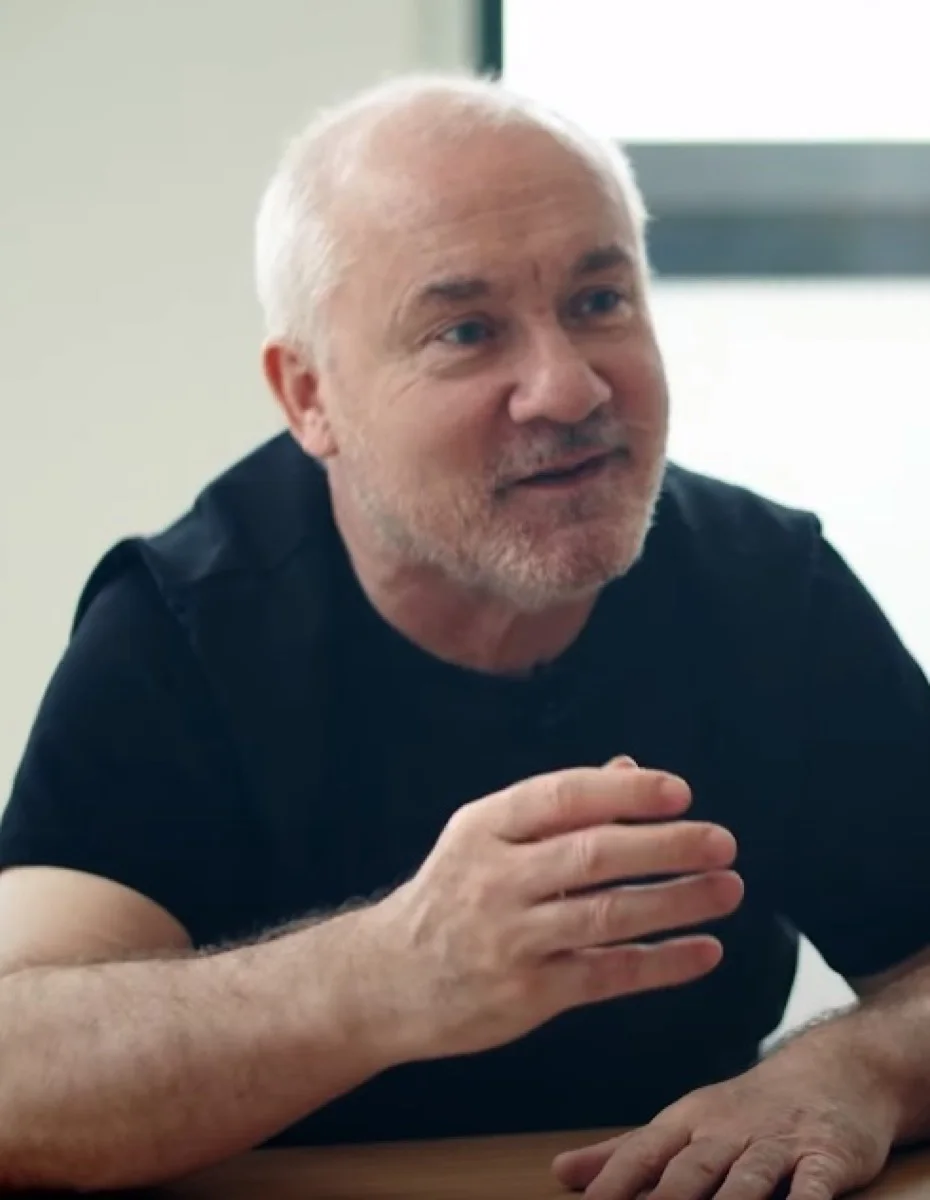
Damien Hirst
Artist
The world’s richest artist handed his iconic Spin Paintings over to a generative algorithm: The Beautiful Paintings (2023) let collectors configure machine-made spins, selling 5,500+ works for $20.9 million in nine days.
Why this score
How the formula works →- +2.6proHas published AI-made work
- +2.6proProfesses love for AI
- +2.5proUses AI in their work
- +1.0pro2 pro-AI statements (forceful)
Weights, statement counts, the ×1.25 multiplier for having a stake in an AI-impacted field, and the formula’s smoothing are already baked in — the points add up to the score: Strongly Pro-AI · 8.7/10
In his words
I really wanted to do something that’s purely generative … I was excited to see if we could make something that generated good looking Spin Paintings that weren’t in the real world. The results have blown my mind!
I have always believed that everything done well is art and there are no boundaries.
Biography
Damien Hirst (born 1965 in Bristol) led the Young British Artists to global notoriety with a shark in formaldehyde and a diamond-encrusted skull, and remains reportedly the world’s wealthiest artist. His career-long theme — outsourcing execution to assistants, factories, and chance — made him an unusually natural early adopter of generative algorithms.
The Beautiful Paintings
In March 2023 Hirst launched The Beautiful Paintings with the art-tech platform HENI: collectors configured their own versions of his signature Spin Paintings — choosing style, palette, format, and title — and a machine-learning-driven generative algorithm, developed with HENI’s data science team over more than a year, produced the works as prints or NFTs. In a nine-day sale the project moved 5,508 works for $20.9 million, with Hirst declaring the results had “blown my mind.”
Critics called it a merchandising operation more than a studio practice — a familiar charge against Hirst, whose market experiments (including his 2021 NFT project The Currency, where buyers chose between a physical work and its token) have always doubled as provocations about value. But the project made him one of the most commercially successful blue-chip artists to hand aesthetic control to an algorithm, extending the spin machine’s randomness — a device he has used since 1994 — into software.
Quote sources
- HENI, 2023(heni.com)
Sources & further reading
Canonical record: https://battlelines.ai/topic/damien-hirst