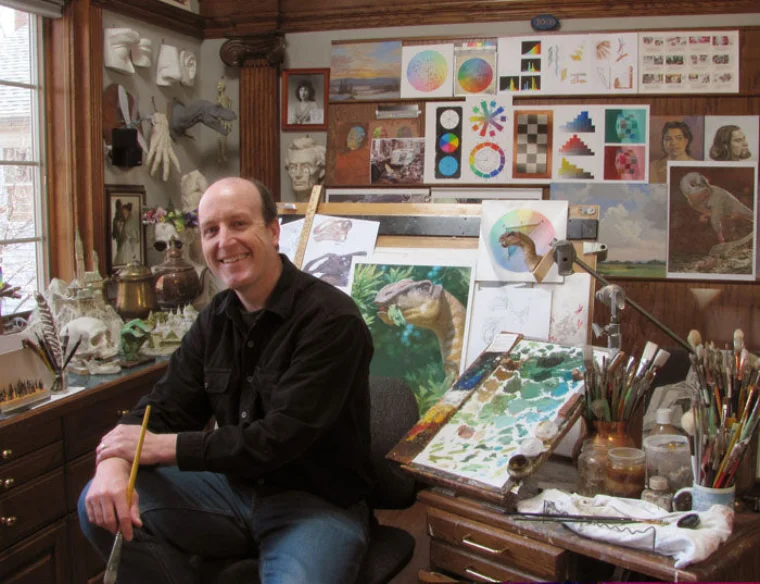
James Gurney
Artist & Author
Painter and author best known for Dinotopia, his best-selling illustrated world of humans and intelligent dinosaurs. A traditional plein-air craftsman who holds one of the most two-sided positions in the debate: genuinely inspired by what generative AI can do and willing to call the best of it “original,” yet unflinching about its harms — the threat to working concept artists, whole disrupted pipelines — and an early advocate that artists share in the proceeds when their name is used to prompt.
Why this score
How the formula works →- 37%nuancedHolds a documented two-sided view
- 31%nuancedSupports AI only with conditions
- 16%pro2 pro-AI statements (measured)
- 16%anti2 anti-AI statements (measured)
Includes the ×1.25 multiplier for having a stake in an AI-impacted field. Evidence splits 16% pro, 16% anti, 68% direction-free → Nuanced
In his words
I’m truly inspired by the results other people are getting with the help of generative models. The people who consistently get the best results often have a computer coding background as well as an aesthetic sense. Is it “art?” Sure, why not? It definitely stimulates my imagination and the good stuff strikes me as original.
Biography
James Gurney (born 1958) is an American artist and author best known for Dinotopia — his lavishly painted, best-selling book series imagining a lost island where shipwrecked humans and intelligent dinosaurs build a shared civilization. The books became a publishing phenomenon and made him one of the most recognizable fantasy illustrators of his generation. He paints prolifically from life, shares his craft through the long-running Gurney Journey blog, and is also the author of the art-instruction books Color and Light and Imaginative Realism.
That pedigree — oils, sketchbooks, painting from life — is exactly why his openness to generative AI is notable. Far from dismissing it, Gurney engages with it as a curious craftsman: studying who gets the best results, crediting the blend of coding and aesthetic judgment behind the strongest work, and finding genuine originality in the output.
There’s a lot of good about generative AI in art. For one thing, there has been a huge surge in appreciation for surrealism and fantasy, because that’s what it does best. I’ve seen a lot of images that are new and exciting. The potentials of the medium are almost limitless. But it’s also scary and threatening, especially to digital artists who are part of corporate entertainment pipelines, such as concept artists.
His stance is strikingly careful — neither booster nor doomer. Gurney sits close to the center of this debate and seems to belong there on purpose: he celebrates the creative surge AI has unleashed while naming, in the same breath, its real harms — the threat to working concept artists, the disruption of whole pipelines. He does not hate the technology, and he refuses to pretend its costs away. As early as April 2022 he was thinking practically about remedies, proposing on his blog that when generators are prompted with a living artist’s name — the fate that befell Greg Rutkowski — that artist should share in any proceeds.
Promise and peril, three years in
Gurney has kept working the question in public. In April 2025 he spent an evening debating AI art with students at Syracuse University — writing afterward that he had planned to avoid the topic, which he wryly called “a toxic swamp filled with wounded birds,” until the students insisted — and in October 2025 he published a Substack essay, “My Issues with AI in the Creative Process,” cataloguing ten craftsman’s objections that have little to do with the usual copyright fights.
We’ve all heard artists gripe about how AI models gulp down copyrighted material and bury us in slop, but that’s not what I want to talk about here. My issues with AI are more fundamental, and I rarely hear anyone mention them.
Even his critiques are workshop notes rather than manifestos — starting with what he calls “option overload,” the way endless machine-offered variations can smother a painter’s own decision-making. Three years into the generative era, he remains what he was on day one: a working artist who takes the tools seriously enough to name precisely what they give and what they take.
Gallery
Quote sources
- Gurney Journey, December 2022(gurneyjourney.blogspot.com)
- Paint Here (Substack), October 2025(jamesgurney.substack.com)
Sources & further reading
Canonical record: https://battlelines.ai/topic/james-gurney