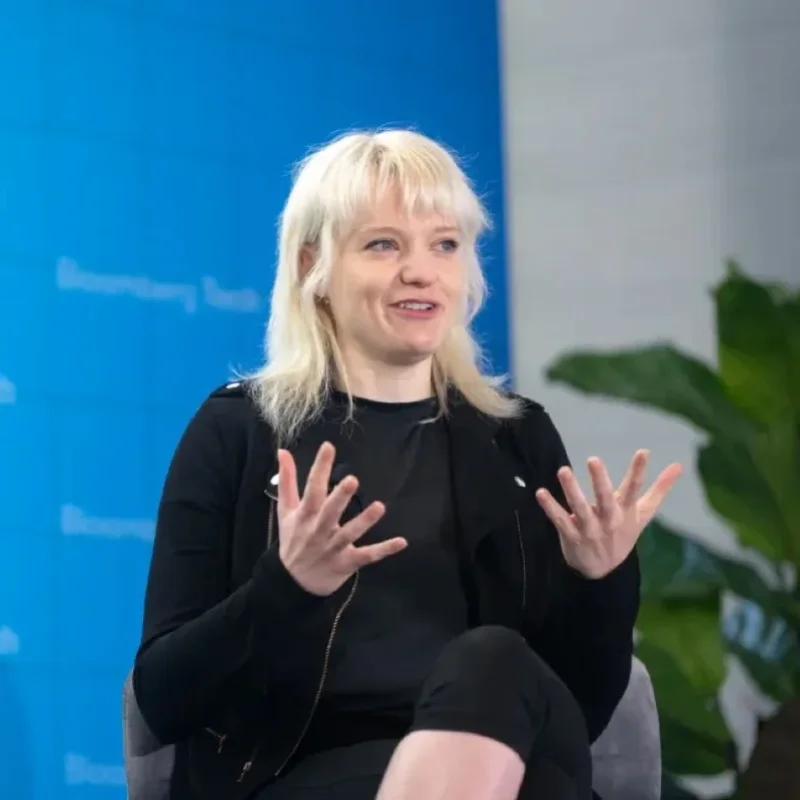
Kate Crawford
AI Researcher & Author
Scholar of AI’s social and political costs and author of “Atlas of AI” (2021), which recasts machine learning as an extractive industry — burning through minerals, energy, hidden labor and scraped data — rather than a bloodless feat of software.
Why this score
How the formula works →- 29%nuancedWorks on AI safety
- 24%nuancedCampaigns for AI safety rules
- 24%nuancedFears big tech will monopolize AI
- 23%anti3 anti-AI statements (forceful)
Includes the ×1.5 multiplier because AI is their life’s work. Evidence splits 0% pro, 23% anti, 77% direction-free → Nuanced
In her words
AI is neither artificial nor intelligent. It is made from natural resources and it is people who are performing the tasks to make the systems appear autonomous.
When you have these huge ambitions to capture and contain the entire world, it is driven by this extractive impulse to get as much data as possible, at any cost.
Biography
Kate Crawford (born 1970) is an Australian-born scholar of the social and political implications of artificial intelligence. A research professor at the University of Southern California Annenberg and a senior principal researcher at Microsoft Research, she has spent more than a decade studying AI not as abstract code but as a physical, political system — and became one of its most influential critics with her 2021 book “Atlas of AI.”
The extractive anatomy of AI
In “Atlas of AI,” Crawford traces the mineral mines, data-labeling sweatshops, energy-hungry data centers and mass-scraped datasets that underwrite modern machine learning. Her argument is that the industry’s language of automation hides an enormous chain of human labor and environmental cost: as she told the Guardian, asking a smart speaker to order toilet rolls “invokes into being this chain of extraction, which goes all around the planet.” She has kept pressing that case as generative AI scaled — a 2024 Nature comment argued that the industry’s energy and water use is being systematically hidden from the public.
The full planetary costs of generative AI are closely guarded corporate secrets.
Crawford’s critique is structural rather than apocalyptic: she is less worried about superintelligence than about the concentrations of power, opacity and ecological toll of the systems being built today. Her earlier work co-founded the AI Now Institute and helped push algorithmic accountability into mainstream policy debate, making her a defining voice for those who read AI as an extension of industrial capitalism.
Quote sources
- The Guardian, 2021(theguardian.com)
- Atlas of AI, 2021(katecrawford.net)
- Nature, 2024(nature.com)
Sources & further reading
- The Guardian: Kate Crawford — “AI Is Neither Artificial Nor Intelligent” (2021)
- CIGI: Kate Crawford on the Toll AI Is Taking on Humans and the Planet (2021)
- USC Annenberg: Kate Crawford Maps a World of Extraction in “Atlas of AI” (2021)
- Nature: Generative AI’s environmental costs are soaring — and mostly secret (2024)
Canonical record: https://battlelines.ai/topic/kate-crawford