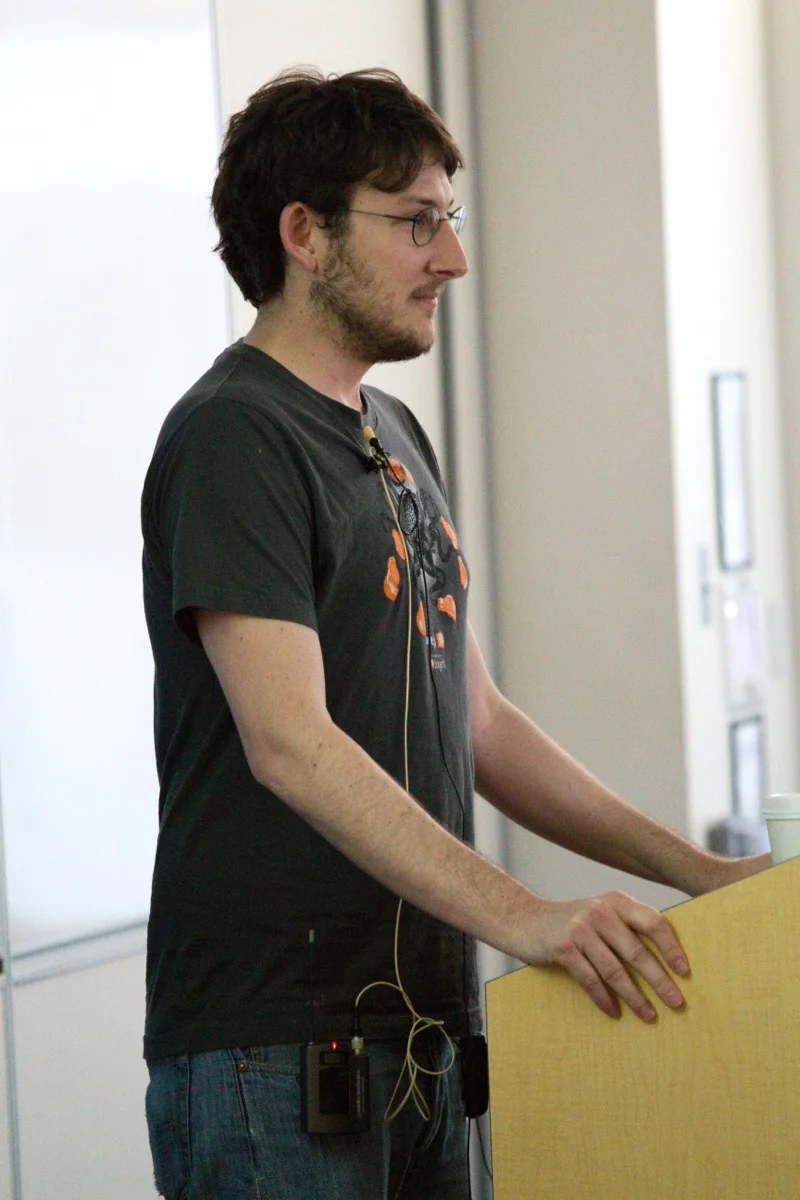
Ryan Dahl
Creator of Node.js and Deno
The engineer who put JavaScript on the server with Node.js and then rebuilt it as Deno. In January 2026 he declared “the era of humans writing code is over” — and weeks later shipped Deno Sandbox, infrastructure purpose-built for safely running AI-generated code.
Why this score
How the formula works →- +6.1proBuilds AI professionally
- +1.6pro2 pro-AI statements (forceful)
Weights, statement counts, the ×1.25 multiplier for having a stake in an AI-impacted field, and the formula’s smoothing are already baked in — the points add up to the score: Strongly Pro-AI · 7.7/10
In his words
Stop and take a moment. Look around. Recognize what’s happening. This is what it feels like to witness the birth of something beyond us. There’s no background music. But it’s happening anyway.
This has been said a thousand times before, but allow me to add my own voice: the era of humans writing code is over. Disturbing for those of us who identify as SWEs, but no less true. That’s not to say SWEs don’t have work to do, but writing syntax directly is not it.
Biography
Ryan Dahl (born 1981) changed the shape of web development twice. In 2009 he unveiled Node.js at JSConf EU — the runtime that took JavaScript out of the browser and onto the server, earning a standing ovation and eventually powering much of the modern web backend. In 2018, in a famous talk on the ten things he regretted about Node, he announced Deno, a security-first successor runtime, and co-founded Deno Land Inc. to build it into a company.
Betting the runtime on AI-written code
On January 19, 2026, Dahl posted the sentence that ricocheted across Hacker News and developer social media: “the era of humans writing code is over.” The claim was not that engineers are obsolete — he was explicit that software engineers still “have work to do” — but that hand-writing syntax is no longer the job. Coming from the person who created the tools much of that syntax was written in, the post read as a milestone rather than a hot take.
Two weeks later he showed the product behind the conviction. On February 3, 2026, Dahl announced Deno Sandbox: lightweight Linux microVMs that boot in under a second, designed for “platforms where users generate code with LLMs, and that code runs immediately without review.” The pitch names the new failure mode of the agent era — LLM-generated code calling external APIs with real credentials, without human review — and answers it with hardware-level isolation, egress control, and secret protection, aimed squarely at AI agents and vibe-coding environments.
The conviction predates the product. In a June 2025 essay on his personal site, “We’re Still Underestimating What AI Really Means,” Dahl argued that framing AI as the next platform shift — mobile, VR, another product cycle — is “much too narrow,” and that what is actually underway is “the emergence of a new non-biological form of intelligent life.” He does not pretend the transition is painless: he writes that jobs will vanish and industries will collapse. But his conclusion is awe rather than alarm, and he faults the industry mainly for not noticing the scale of what it is doing.
It is a distinctive position among language and runtime creators, many of whom — like Rich Hickey — recoil from AI-generated code. Dahl’s view is the infrastructuralist’s: if machines are going to write most software, the interesting engineering problem is making that safe, fast, and productive.
Quote sources
- tinyclouds.org, 2025(tinyclouds.org)
- X, January 2026(x.com)
Sources & further reading
Canonical record: https://battlelines.ai/topic/ryan-dahl