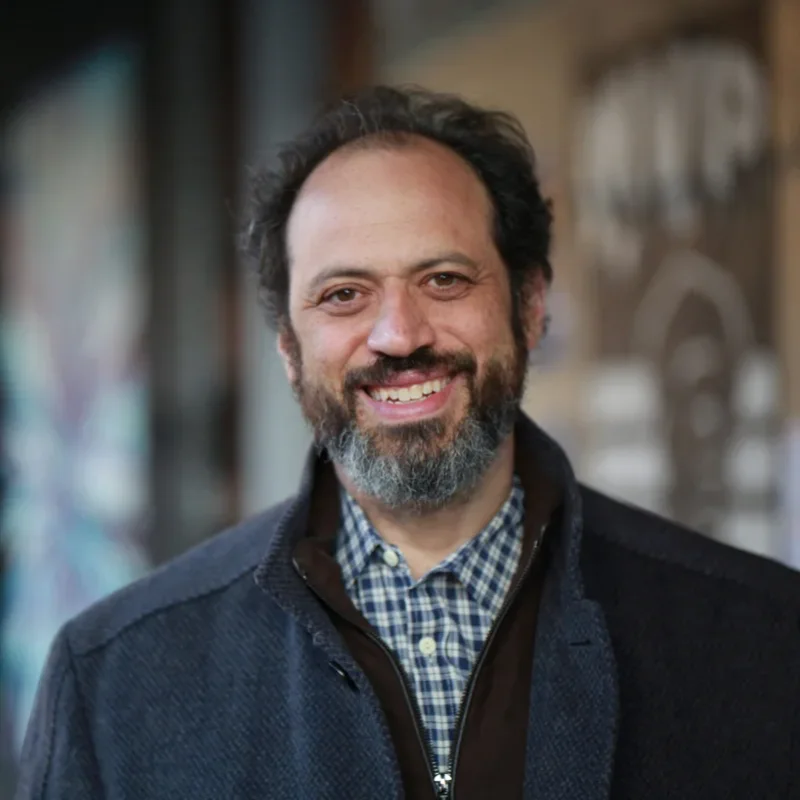
Zeynep Tufekci
Sociologist and New York Times columnist
Princeton sociologist and New York Times columnist with a record of early calls on technology’s harms. She argues AI’s real threat is surveillance, manipulation, and eroded privacy — not science-fiction extinction — and that the hype is colliding with unreliability.
Why this score
How the formula works →- +3.6antiCalls AI overhyped
- +2.8anti3 anti-AI statements (forceful)
Weights, statement counts, the ×1.25 multiplier for having a stake in an AI-impacted field, and the formula’s smoothing are already baked in — the points add up to the score: Firmly Anti-AI · 6.4/10
In her words
We’re building this infrastructure of surveillance authoritarianism merely to get people to click on ads.
The idea that millions of people are going to be speaking to a machine that speaks like a human, talks with them, we don’t even have language or concepts to understand. This is one of the biggest historic deals ever in human history.
Biography
Zeynep Tufekci is a Turkish-American sociologist, born in Istanbul and trained first as a computer programmer, who is now the Henry G. Bryant Professor of Sociology and Public Affairs at Princeton University and an opinion columnist at The New York Times. A 2022 Pulitzer Prize finalist for commentary, she built a reputation for being right early — on social media’s role in protest movements (“Twitter and Tear Gas,” 2017), on algorithmic radicalization, and on the pandemic — that gives her technology warnings unusual weight.
The real threat is not the robot apocalypse
Tufekci’s through-line on AI predates ChatGPT: her 2017 TED talk warned that machine learning built for ad targeting was quietly assembling the infrastructure of authoritarian control. In her columns she has consistently argued that existential-risk talk, however exciting, distracts from AI’s actual and present dangers — mass surveillance, privacy erosion, algorithmic manipulation of what billions of people see and believe — harms she links to the early stages of authoritarianism.
She is equally hard on the industry’s promises. In a June 2026 Times column, “The Unstoppable Force of A.I. Hype Is Meeting One Immovable Fact,” she argued that industry-stoked fears of AI taking every job keep colliding with the technology’s unreliability, citing chatbot fiascos from Air Canada’s invented refund policy to McDonald’s abandoned drive-through bots. At Elon University’s Baird Lecture that spring she called conversational AI genuinely epochal while pressing for verification systems “compatible with democracy, privacy” — and told students the scale of the problem was no excuse for fatalism: “Don’t let anybody tell you this is so big that we can’t do anything.”
Tufekci files as anti not for opposing AI’s existence but for a decade of sustained public warnings: that the companies deploying it are unaccountable, that its surveillance substrate is corrosive to democracy, and that both the doom narrative and the jobs-apocalypse narrative serve the industry’s interests more than the public’s.
Quote sources
- TED, 2017(ted.com)
- Elon University (Baird Lecture), 2026(elon.edu)
Sources & further reading
Canonical record: https://battlelines.ai/topic/zeynep-tufekci