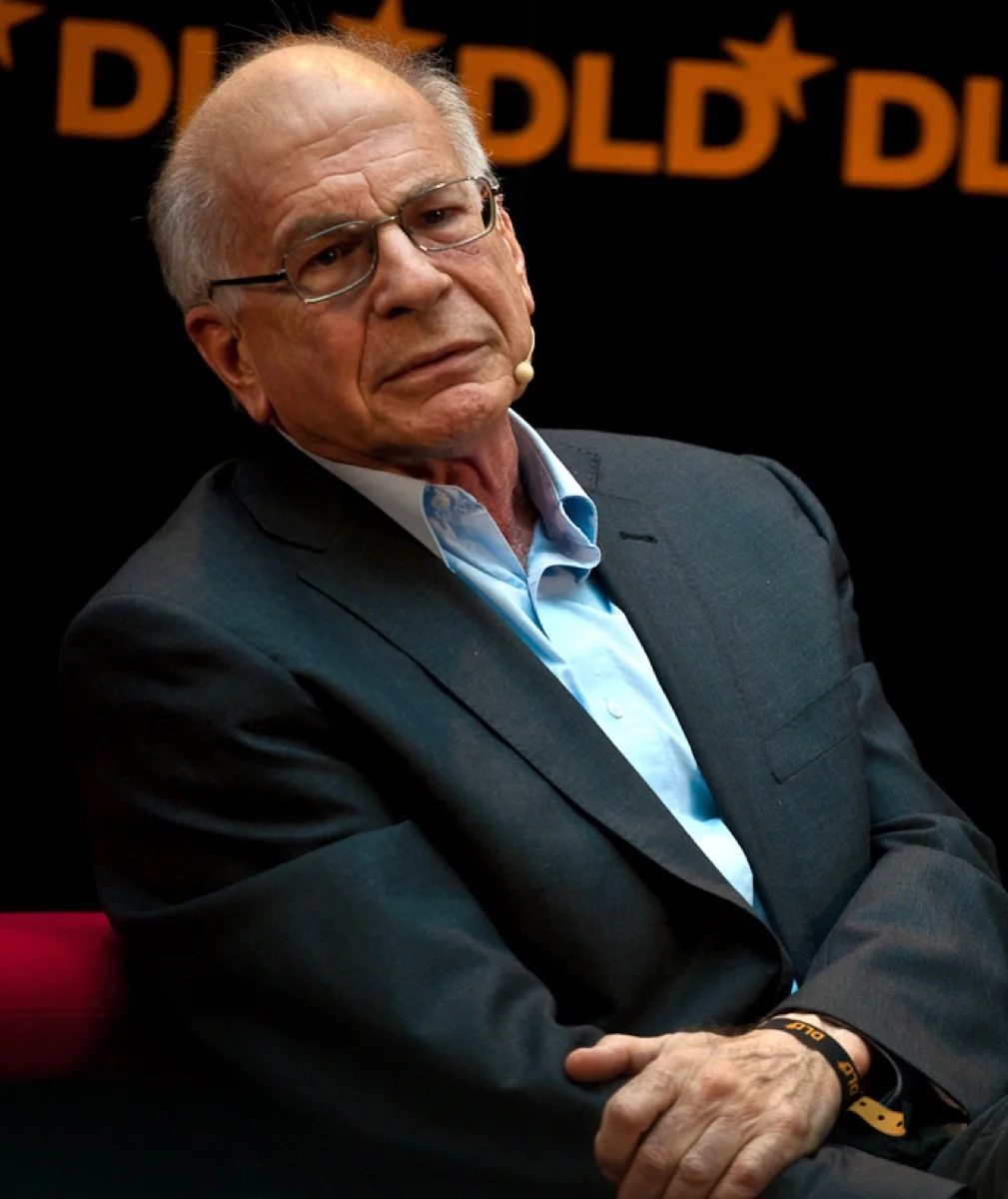
Daniel Kahneman
Nobel-Winning Psychologist
The Nobel laureate who mapped human irrationality in “Thinking, Fast and Slow.” Having spent a career documenting how noisy human judgment is, he concluded algorithms simply judge better: “Clearly AI is going to win. It’s not even close.”
Why this score
How the formula works →- +2.9pro2 pro-AI statements (forceful)
Weights, statement counts, and the formula’s smoothing are already baked in — the points add up to the score: Leaning Pro-AI · 2.9/10
In his words
And clearly AI is going to win [against human intelligence]. It’s not even close. How people are going to adjust to this is a fascinating problem — but one for my children and grandchildren, not me.
Biography
Daniel Kahneman (1934–2024) was an Israeli-American psychologist who, with Amos Tversky, founded the study of cognitive biases and won the 2002 Nobel Prize in economics for prospect theory. His 2011 bestseller “Thinking, Fast and Slow” made the fallibility of human judgment common knowledge.
Why the algorithms win
Kahneman’s late work sharpened the argument for machine judgment. “Noise: A Flaw in Human Judgment” (2021, with Olivier Sibony and Cass Sunstein) documented how experts given the same facts — judges, doctors, underwriters — scatter wildly in their conclusions, while even simple rules stay consistent. In a Guardian interview that year he drew the conclusion bluntly: humans are linear creatures facing exponential change, some medical specialties are “clearly in danger of being replaced, certainly in terms of diagnosis,” and once AI shows better business judgment, human leadership itself comes into question.
His confidence was descriptive, not celebratory — he wondered openly what widespread superiority of machine judgment would do to human self-regard, and left the adjustment “for my children and grandchildren.” He died in March 2024, just as the systems he predicted began outscoring clinicians in diagnostic studies.
Quote sources
- The Guardian, 2021(theguardian.com)
Sources & further reading
Canonical record: https://battlelines.ai/topic/daniel-kahneman