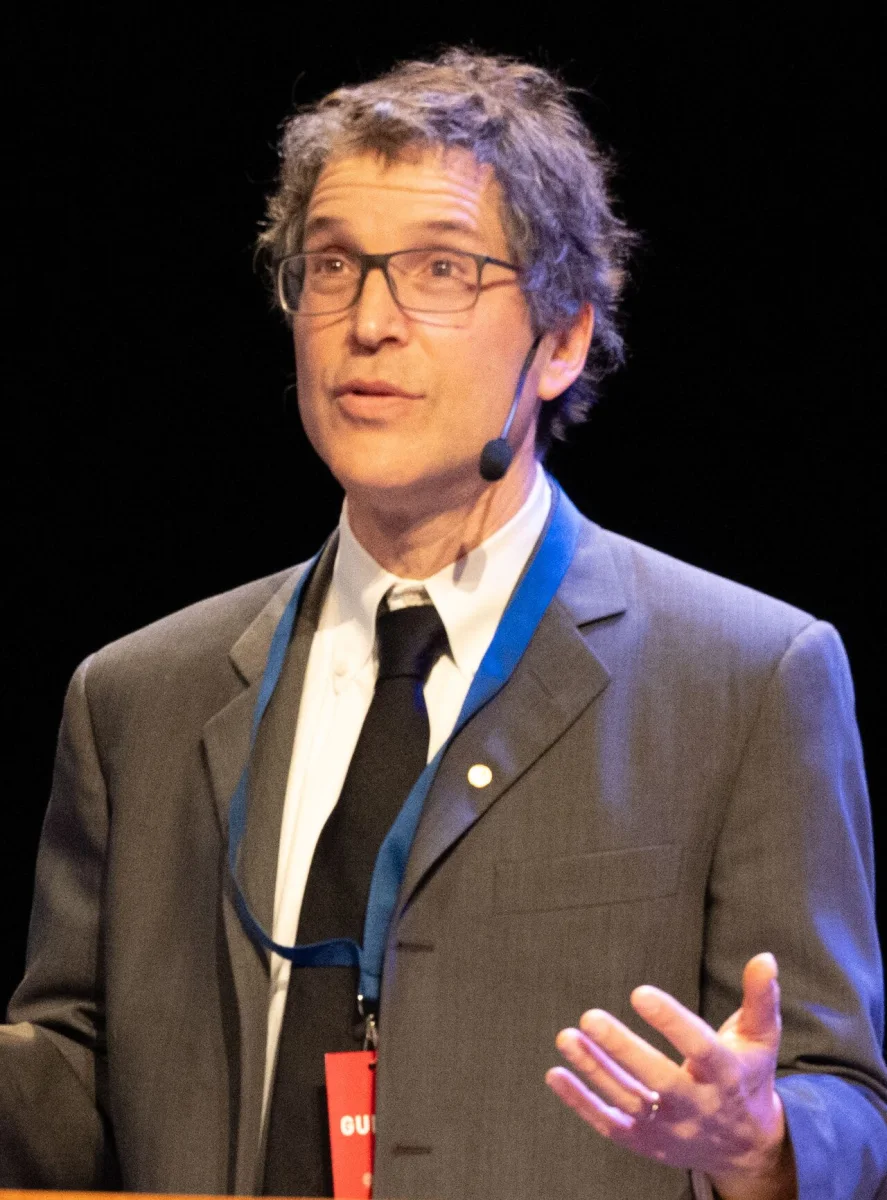
David Baker
Biochemist
Biochemist who shared the 2024 Nobel Prize in Chemistry for computational protein design. His lab’s AI tools have become the showcase for AI-accelerated science — building new proteins to fight cancer, viruses and disease.
Why this score
How the formula works →- +4.0proBuilds AI professionally
- +2.4proUses AI in their work
- +1.6proRecognized for AI work
- +0.9pro2 pro-AI statements (forceful)
Weights, statement counts, the ×1.25 multiplier for having a stake in an AI-impacted field, and the formula’s smoothing are already baked in — the points add up to the score: Strongly Pro-AI · 8.9/10
In his words
By designing proteins not found in nature, I believe we will solve many urgent challenges across medicine, technology, and sustainability.
Biography
David Baker (born 1962) is an American biochemist and computational biologist at the University of Washington, where he directs the Institute for Protein Design. In 2024 he was awarded half of the Nobel Prize in Chemistry for computational protein design; the other half went to DeepMind’s Demis Hassabis and John Jumper for predicting protein structures with AlphaFold.
AI-designed proteins
Baker’s lab pioneered the software — Rosetta, RoseTTAFold and the diffusion-based RFdiffusion — that lets scientists dream up entirely new proteins atom by atom, rather than merely cataloguing those evolution already made. He credits deep learning with transforming the field: DeepMind’s AlphaFold2, he has said, was “a wake-up call” to the power of the approach, one that inspired rather than threatened his own team. Where earlier design methods succeeded once in tens of thousands of tries, AI-driven diffusion pushed success rates into the single-digit percentages.
AlphaFold2 was really kind of a wake-up call for me to the power of deep learning.
The payoff is concrete: designer proteins that neutralize viruses, target cancer cells, and contributed to computationally designed vaccine components. Baker runs a “communal brain” of more than a hundred researchers and has become the leading real-world advocate for AI as an accelerant of scientific discovery — the counterweight, in the debate, to those who see the technology mainly as hype or hazard.
Quote sources
- University of Washington, 2024(newsroom.uw.edu)
- NobelPrize.org, 2024(nobelprize.org)
Sources & further reading
Canonical record: https://battlelines.ai/topic/david-baker