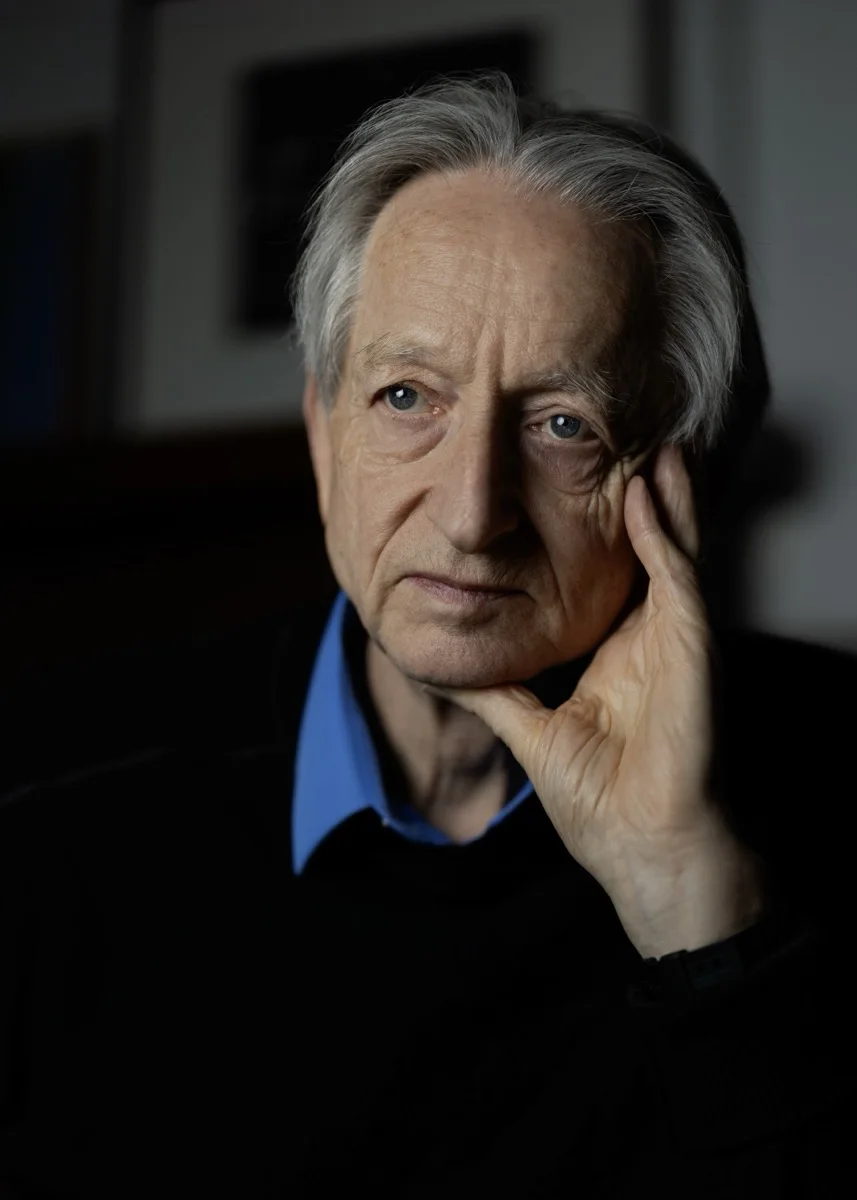
Geoffrey Hinton
AI Researcher
The “godfather of AI” and Nobel laureate whose neural-network breakthroughs built the modern field — and who quit Google in 2023 to warn the world that his life’s work could end it.
Why this score
How the formula works →- 24%proBuilds AI professionally
- 19%antiPredicts AI catastrophe
- 14%antiWalked away over AI concerns
- 11%nuancedHolds a documented two-sided view
- 10%proRecognized for AI work
Includes the ×1.25 multiplier for having a stake in an AI-impacted field. Evidence splits 37% pro, 42% anti, 21% direction-free → Nuanced
In his words
I console myself with the normal excuse: If I hadn’t done it, somebody else would have.
These things could get more intelligent than us and could decide to take over, and we need to worry now about how we prevent that happening.
Biography
Geoffrey Hinton (born 1947) is a British-Canadian cognitive scientist whose stubborn decades-long faith in neural networks created modern AI. His 1986 work popularizing backpropagation, and the 2012 AlexNet breakthrough with his Toronto students Alex Krizhevsky and Ilya Sutskever, ignited the deep-learning revolution. He shared the 2018 Turing Award with Yoshua Bengio and Yann LeCun, and won the 2024 Nobel Prize in Physics with John Hopfield for foundational discoveries enabling machine learning.
The defection
In May 2023, after a decade at Google, Hinton resigned so he could — in his words — speak freely about the risks of AI. The announcement, made in a New York Times interview, landed like a thunderclap: the field’s most decorated architect now warned of misuse by bad actors, mass technological unemployment, and the existential risk that machines smarter than humans might escape our control. Later that month he was the first signatory of the Center for AI Safety statement declaring that mitigating the risk of extinction from AI should be a global priority alongside pandemics and nuclear war.
His timelines have only shortened. During Nobel Week in December 2024 he said there was a good chance — around fifty percent — of AI smarter than humans within five to twenty years, down from his earlier estimate of thirty to fifty, and used his laureate’s platform to call for urgent safety research into controlling systems smarter than ourselves.
Hinton is a warner, not a hater: he still champions AI’s benefits in medicine and education, and he does not believe development can simply be stopped. His position is closer to a climate scientist’s than a Luddite’s — the technology works, which is exactly the problem.
Quote sources
- The New York Times, 2023(nytimes.com)
Sources & further reading
Canonical record: https://battlelines.ai/topic/geoffrey-hinton