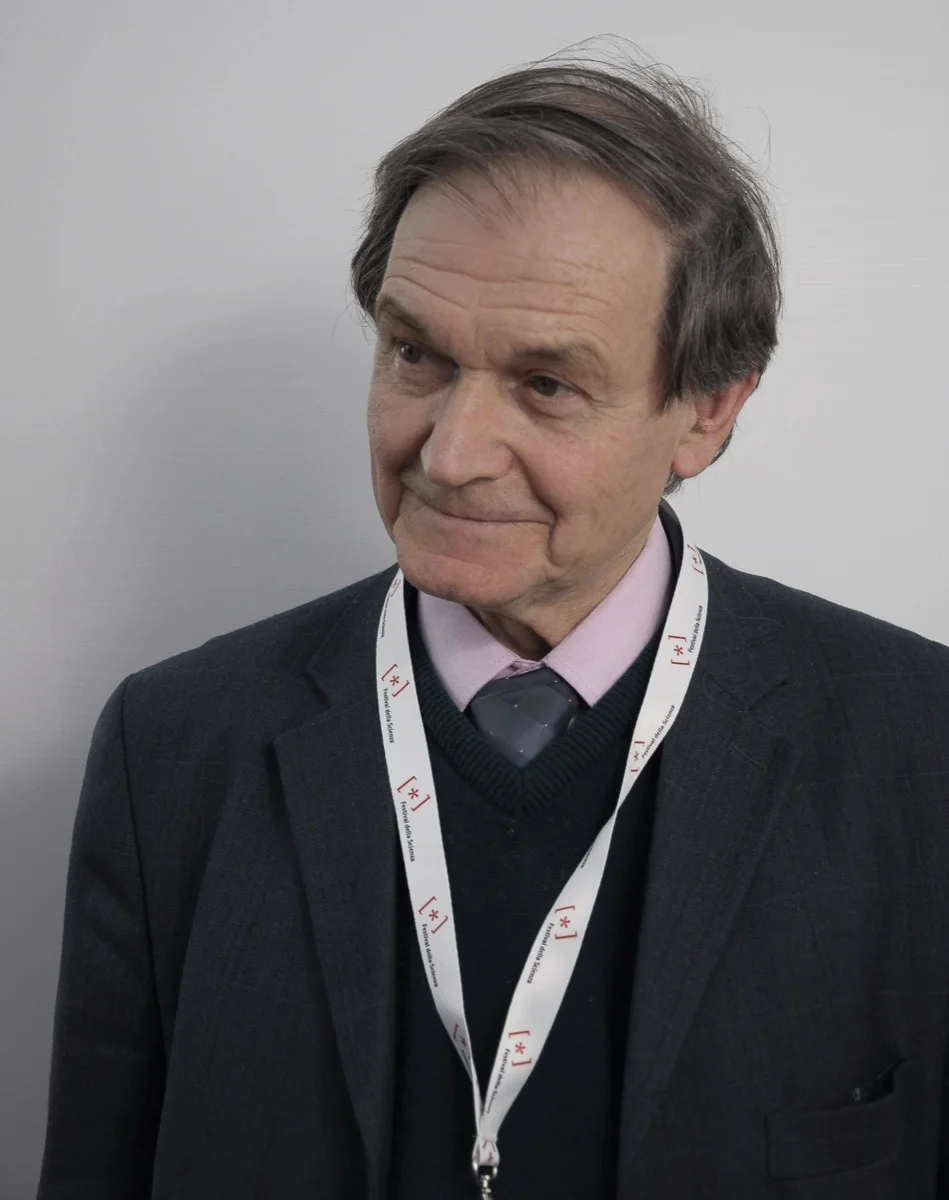
Roger Penrose
Mathematical Physicist
Nobel-winning mathematical physicist who has argued since “The Emperor’s New Mind” (1989) that consciousness is non-computable — and that today’s “AI” is a misnomer for what he prefers to call artificial cleverness.
Why this score
How the formula works →- +4.6antiAnti-AI for 15+ years
- +1.5anti2 anti-AI statements (measured)
Weights, statement counts, and the formula’s smoothing are already baked in — the points add up to the score: Firmly Anti-AI · 6.1/10
In his words
AI is a bad term. It means artificial intelligence. Now, intelligence, in my view, is conscious. That’s what intelligence is about. So how can I call it? Artificial cleverness. How about that? AC.
Biography
Sir Roger Penrose (born 1931) is a British mathematical physicist who shared the 2020 Nobel Prize in Physics for his work showing that black-hole formation is a robust prediction of general relativity. A collaborator of Stephen Hawking and inventor of the Penrose tiling, he has for decades pursued a heterodox theory that human consciousness cannot be reduced to computation.
Consciousness is not a computation
Penrose’s 1989 book “The Emperor’s New Mind” — written partly in reaction to claims that the brain is “just a computer made of meat” — argued that human understanding relies on non-computable processes, invoking Gödel’s incompleteness theorem. With anesthesiologist Stuart Hameroff he later proposed that quantum effects in the brain’s microtubules give rise to consciousness. The theory remains contested, but Penrose has never wavered from its central conclusion.
First of all, the name is wrong. It’s not artificial intelligence. It’s not intelligence. Intelligence would involve consciousness, and I’ve always been a strong promoter of the idea that these devices are not conscious and they will not be conscious unless they bring in some other ideas.
That view makes Penrose a persistent skeptic of the language surrounding large models. To him, a system that calculates without understanding is clever, not intelligent — like a mathematics student who can reproduce a technique flawlessly while grasping none of it. His objection is philosophical rather than economic or political: he does not fear the machines so much as insist we are misdescribing them, a stance that puts him at odds with consciousness-agnostics like Richard Dawkins.
Quote sources
- This Is The World interview, 2025(youtube.com)
Sources & further reading
Canonical record: https://battlelines.ai/topic/roger-penrose