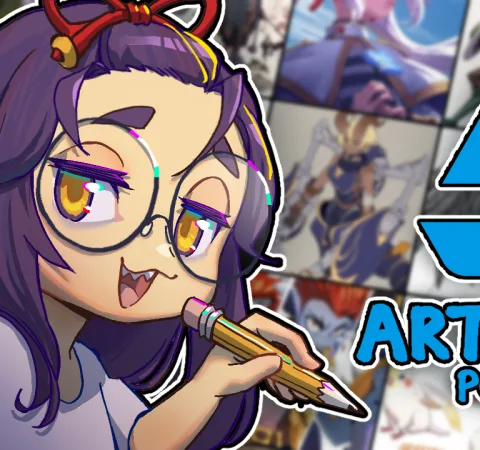
pikat
Illustrator & YouTuber
Pseudonymous Hong Kong illustrator and VTuber whose art-education YouTube channel — nearly a million subscribers — doubles as one of the most-watched artist critiques of generative AI, which she calls theft on a massive scale.
Why this score
How the formula works →- +5.0anti5 anti-AI statements (forceful)
Weights, statement counts, the ×1.25 multiplier for having a stake in an AI-impacted field, and the formula’s smoothing are already baked in — the points add up to the score: Firmly Anti-AI · 5.0/10
In her words
Below that sparkling veneer is a less pleasant truth: the fact that these AI models are only capable of doing what they’re doing through committing theft on an absolutely massive scale.
I value the process of art making as much if not more than the resulting artwork itself, which is why touting generative AI as a tool seems kind of nonsensical — it’s akin to handing me a machine to watch movies for me or play video games for me.
Why choose to be inspired by a machine-made facsimile produced by homogenizing millions of human artworks into an unrecognizable amalgamation?
Biography
pikat is the pseudonymous, Hong Kong–based digital illustrator and VTuber behind one of YouTube’s largest art-education channels, with close to a million subscribers. She drew as a child, quit for more than a decade to work as a software engineer, and picked up the pencil again in late 2019 — by her own telling, to draw Fire Emblem fan art. She streams and appears only through stylized self-representations — a bespectacled pixel-art VTuber model and an egg-yolk mascot — and has never disclosed her real name.
The engineer’s case against generative AI
Her software background gives her AI videos an unusual texture: they explain the technology before condemning it. In “Is AI stealing your art? (GenAI explained)” (July 2024) she walks through diffusion models, CLIP, and the LAION-5B dataset — noting the irony that alt text written to help vision-impaired humans now feeds “vision-impaired machines” — and concludes that because it is impossible to ask millions of artists for consent, “they didn’t,” citing Midjourney founder David Holz’s admission that there is no way to trace a hundred million training images to their owners.
I think that for millions of artists, the fact that their life’s work is being taken without permission in order to create a machine to replace them is reason enough to oppose how generative AI models are created today.
In “Why artists don’t like AI (it’s not just the theft)” (September 2024) she goes further than most critics: even a hypothetical “100% ethical” model trained with full consent would not win her over, because for her the intentionality of each mark — not the finished image — is what makes art worth caring about. She is candid about the technology’s capability, conceding on camera that AI is now better at drawing than she is, and that once it is “basically impossible” for laypeople to tell machine images from human work, some are already passing off generated images to unsuspecting commission clients. Style-mimicry models of the kind she described continue to circulate — by November 2025 a LoRA labeled “Pikat Style” was itself listed on Civitai.
A December 2024 stream, “Can you spot the AI art?,” turned the problem into a Turing test — her viewers (and occasionally pikat herself) repeatedly misjudged which images were human-made. And in February 2026, after Larian Studios CEO Swen Vincke said the studio was “pushing hard” on generative AI for its Divinity trailer, her video “Can AI make good concept art?” argued that AI reference images fall apart under a concept artist’s scrutiny and called for AI-content disclosure labels on games and media — “more information is always good for consumers, no matter what your stance is.” Larian later pledged to refrain from generative AI during concept-art development.
Quote sources
- YouTube, 2024(youtube.com)
- YouTube, 2026(youtube.com)
Sources & further reading
Canonical record: https://battlelines.ai/topic/pikat